
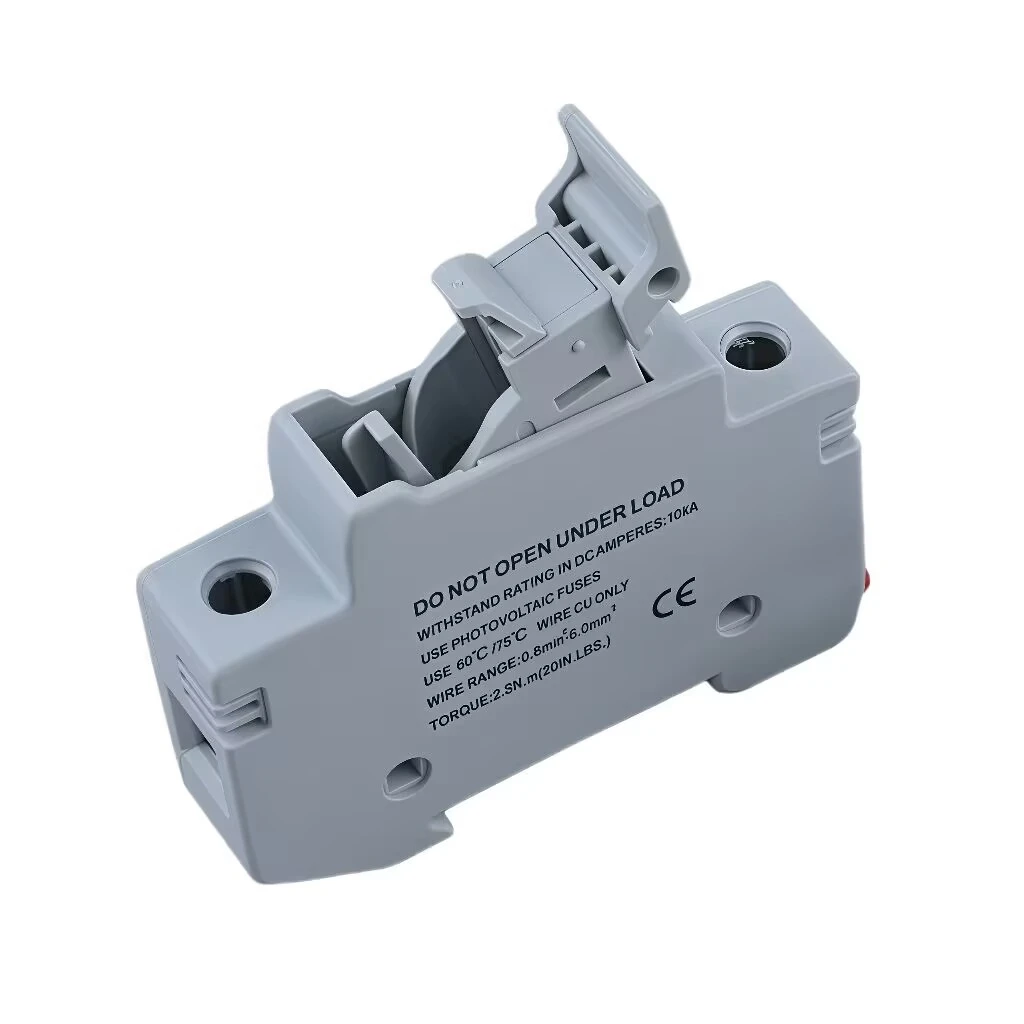
Outdoor DC enclosures fail from the environment far more often than they fail electrically. Water finds a cable gland that was never properly seated. Ultraviolet radiation chalks a holder body until it cracks. Condensation forms inside a sealed box every night for a year and quietly corrodes every terminal in it. Selecting a solar fuse holder without specifying its ingress protection and UV resistance is the most common reason those things happen. This article explains what the ratings mean and how to choose them for a given location.
What the IP Code Actually Promises
The IP code has two digits. The first rates protection against solid objects, the second against water. For outdoor electrical work the numbers that matter are:
- IP54 — dust protected and splash resistant, adequate only for a sheltered location
- IP65 — dust tight and protected against water jets, the practical minimum for exposed outdoor use
- IP66 — dust tight and protected against powerful water jets, suitable for exposed locations including washdown areas
- IP67 — dust tight and protected against temporary immersion, appropriate where temporary flooding or standing water is possible
- IP68 — dust tight and protected against continuous immersion under conditions defined by the manufacturer
Two cautions. First, the second digit is tested under defined conditions of duration and pressure, so IP67 is not a promise of permanent underwater operation. Second, the rating applies to the product as tested. An assembly's real rating is set by its weakest point, which is almost always a cable entry rather than the holder body.
Which Rating Suits Which Location
Match the rating to where the equipment actually is, not to a generic specification:
- Inside a sealed, weatherproof combiner box rated IP65 or better: the holder itself can be a lower rating, because the enclosure does the work. Confirm the enclosure rating is real and maintained
- Rooftop array with the holder in an enclosure exposed to driving rain: IP65 minimum for the enclosure and its entries
- Ground-mount in an area subject to standing water or flooding: IP67 for the enclosure assembly
- Coastal or desert installations: IP66 or better, plus explicit attention to salt mist or abrasive dust
- Any location that may be hosed down during cleaning: IP66 minimum
The general principle is that the holder should not be the component that limits the assembly. Specify it to at least the rating of the enclosure it sits in.
UV Is a Separate Requirement From IP
This is the point most specifications miss, because IP and UV are completely independent tests. A product can be IP68 and still chalk, craze, and crack after three years in direct sun. Ultraviolet degradation affects the holder body, the gaskets, the cable glands, and any exposed latching features. The visible signs are colour fading, a chalky surface, and eventually fine cracks. The functional consequences are loss of sealing, loss of mechanical strength, and loss of retention force on the device. When specifying for solar duty, ask directly about UV resistance. Look for materials rated for continuous outdoor exposure and for test evidence against UV ageing standards, rather than assuming that a black plastic body is inherently UV stable. Some colours and some polymer formulations perform much better than others. If the holder is inside an opaque, UV-stable enclosure, the requirement is relaxed — but any part exposed outside that enclosure still needs to be rated for it.
Why the Cable Entry Decides the Real Rating
A perfectly rated holder in a perfectly rated box can still end up with water inside, and the reason is nearly always the cable entry. Consider the full path:
- Cable glands must be sized to the actual cable diameter, not to the nearest size available
- Glands must be tightened to their specified torque; a finger-tight gland is not sealed
- Unused entries need proper blanking plugs, not tape or nothing
- Gland material must be UV resistant where it is exposed
- Cable should enter from below or with a drip loop so water does not track along it into the enclosure
- Gaskets on the enclosure lid must be seated, clean, and not compressed beyond their design limit
Installers get most of this right individually and miss one item, which is all it takes. A single unsealed entry defeats the entire rating.
Temperature Cycling and the Sealing System
There is a mechanism here that surprises people. A sealed enclosure breathes. Every day the air inside heats and expands, and every night it cools and contracts. Over a year that is several hundred pressure cycles, and each one moves a small volume of air — and the moisture it carries — through any path that exists. That path might be a marginally seated gland or a microscopically imperfect gasket. The result is moisture accumulating inside a box that has never been opened and is nominally sealed. Over time it corrodes terminals, raises contact resistance, and produces the heating failures that get blamed on the devices. Two mitigations are worth specifying: proper breathable vents that equalise pressure while blocking liquid water and dust, and a maintenance interval that checks gaskets and glands before the third summer rather than after it.
A Specification Checklist
Before ordering, confirm each of these in writing:
- IP rating of the holder, matched to at least the rating of the enclosure
- UV resistance of the holder body, gaskets, and any exposed latches, with test evidence
- Cable gland sizes matched to actual cable diameters, and blanking plugs for unused entries
- Operating temperature range covering the measured worst-case internal temperature
- Material compatibility with the environment: salt mist, ammonia, abrasive dust as applicable
- Voltage and current ratings appropriate to the string, with derating for enclosure temperature
- Whether the enclosure uses a breathable vent, and the maintenance interval for seals
Summary
For exposed outdoor solar work, IP65 is the practical floor and IP66 or IP67 is appropriate where water jets, standing water, or washdown are expected. UV resistance is a separate requirement that must be asked for by name. And the real rating of the installation is decided at the cable entries and the gaskets, not by the number printed on the holder.
About Our Outdoor Holder Range
GFEFUSE is the brand of Dongguan Gongfu Electronics Co., Ltd., an electronic protection device manufacturer founded in Dongguan, Guangdong in 2013. We develop, produce, and sell fuses, fuse holders, and fuse boxes, supported by five advanced production lines and thirteen R&D engineers, and our products are exported to customers overseas. Our fuse holder range includes options for outdoor DC service, including panel fuse holder configurations for enclosure mounting and bolt fuse holder options for high-current string and array connections. Solar designs typically pair these with our photovoltaic fuse range so the link and holder are verified as a set. Products carry UL, cULus, TUV, CE, and CQC certification and comply with RoHS and REACH directives, serving new energy, power equipment, communication systems, automotive electronics, and consumer electronics.
Conclusion
IP rating and UV resistance answer two different questions, and a solar holder needs both answered. Then the installation has to live up to the specification, which means correctly sized glands, seated gaskets, blanked unused entries, and an annual check before summer rather than after a failure.
Tell us your installation location, enclosure rating, cable sizes, and expected temperature range. We will confirm the right holder, sealing approach, and matching link.
Frequently Asked Questions
Direct answers on specifying holders for outdoor solar duty.
What IP rating does a solar fuse holder need?
IP65 is the practical minimum for exposed outdoor use. Specify IP66 where water jets or washdown are expected, and IP67 where standing water or temporary flooding is possible. Always match at least the rating of the enclosure it sits in.
Does an IP rating include UV resistance?
No. They are independent tests. A product can be fully sealed against water and still degrade in sunlight. Ask for UV resistance separately, with material or test evidence for continuous outdoor exposure.
Can a holder inside a sealed enclosure have a lower rating?
Yes, provided the enclosure rating is genuine and maintained. In that case the enclosure does the work, and the holder only needs to suit the internal environment — though condensive humidity inside the box still requires attention to materials.
What usually lets water into a sealed solar enclosure?
Cable entries. Glands sized to the wrong cable diameter, finger-tight glands, missing blanking plugs on unused entries, and degraded gaskets are responsible for most ingress, not the enclosure body.
Why does moisture appear inside an enclosure that was never opened?
Pressure breathing. Daily heating and cooling cycles move moist air through any available path. Breathable vents that block liquid water, plus annual seal inspection, address the mechanism directly. For a solar fuse holder that lives in a rooftop combiner box, this breathing effect is amplified by the daily on-off cycle of the array, so the inspection interval on gaskets and glands should be aligned with the same annual rhythm rather than waiting for visible damage to appear.